Kakobuy US
Celine Sunglasses QC Check: Lenses, Frames, Hinges
## What This Guide Covers and Its Limits for Celine Sunglasses QC This guide is for the Celine brown sunglasses product page on fashion-reps, helping buyers complete a visible-item check based on QC photos before placing an order, and decide the next step: keep, ask for more photos, or pause the purchase. This article only covers appearance judgments that photos can support. It does not treat QC photos as proof of authenticity, materials, or wearing experience. Real weight, lens optical performa
- Published on this site
- Maya Chen
Maya Chen is Editor-in-Chief at Kako US, leading the testing team and writing its knife reviews. The focus is edge geometry, heat treatment and performance in American home kitchens, with coverage also extending to whetstones and cookware. Knife testing uses the desk's five-point scale and timed cutting protocol, and Maya personally sharpens every knife through a 1000/6000 grit progression beforehand. Edge retention is recorded with a BESS tester and every result enters the comparison tables, connecting sharpening preparation, test readings and the comparison of knives.
Editor score 4.2 / 5
What This Guide Covers and Its Limits for Celine Sunglasses QC
This guide is for the Celine brown sunglasses product page on fashion-reps, helping buyers complete a visible-item check based on QC photos before placing an order, and decide the next step: keep, ask for more photos, or pause the purchase.
This article only covers appearance judgments that photos can support. It does not treat QC photos as proof of authenticity, materials, or wearing experience. Real weight, lens optical performance, wearing comfort, UV protection, and long-term durability cannot be confirmed from photos alone. The product page shows this model as a 2024 everyday style with brown frames; the page notes also indicate that specific lens width and temple size need to be checked again before ordering. The check is based on the page update information dated September 26, 2026, for time reference; price, stock, service fees, and international shipping should still be based on the shopping agent's checkout page.

Applies when: the product details page has a View QC Photos button and it opens the corresponding QC photos.
Does not apply when: there are only main product images, category thumbnails, or other product images; photos are blurry or lack key angles; when you need to confirm authenticity, lens protection performance, or actual wearing effect.
Open View QC Photos from the Celine Product Details Page
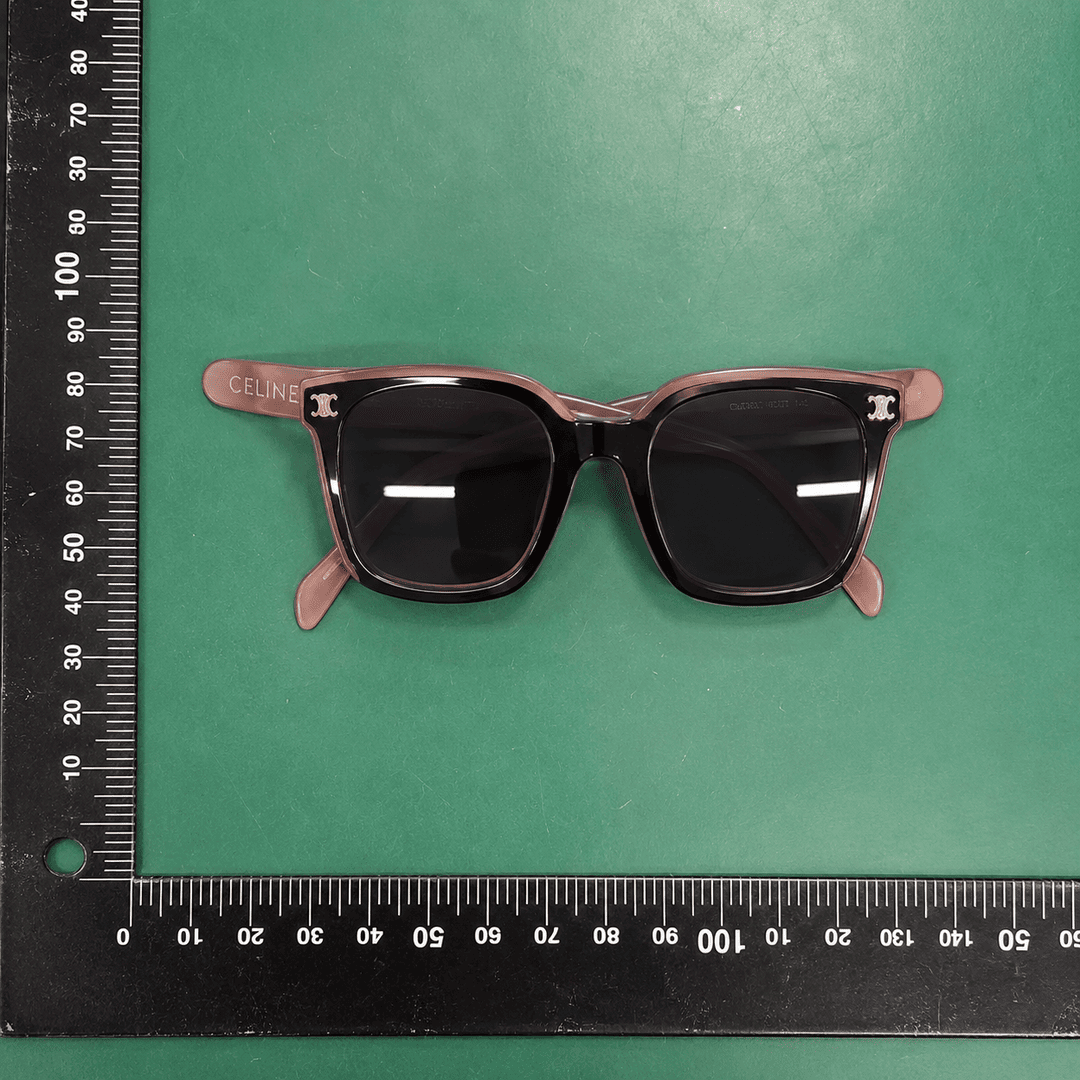
First open the product details page for these Celine brown sunglasses on fashion-reps, then click the button labeled View QC Photos. Do not treat guessed URLs, search result thumbnails, or other Celine product images as QC evidence for this item.
After entering the gallery, confirm three things:
- The product name shown on the page matches the current item, not a similar model or another pair from the same brand.
- The photos are indeed from this item's QC gallery, not product main images, brand pages, or category pages.
- At least one structural element such as lenses, frames, temples, or hinges can be identified in the photos; if only a partial view is available, limit conclusions to that part.
It is recommended to keep a simple photo log: photo number, shooting angle, visible parts, confirmed facts, unconfirmed items. This avoids recording the same reflection, shadow, or compression artifact as multiple issues. 🔎
Check the Visible Condition of Lens Surfaces, Color, and Left-Right Symmetry
Look at the lenses first, not the brand logo. Check in this order:
- Lens surfaces: check for continuous scratches, obvious chips, foggy areas, debris, or spots that cannot be explained by lighting. A white bright spot in a single photo could be a light reflection, so only record it as a visible anomaly to ask about if it appears repeatedly in QC photos from different angles.
- Lens color: confirm that the tint of the left and right lenses is roughly consistent, with no obvious color shift on one side. Brown frames do not mean brown lenses; color judgment should be limited to the visible appearance in photos and should not infer actual light transmission or protection level.
- Left-right symmetry: compare the edges of the lenses, frame height, and bridge connection on both sides. Slight angle differences may come from how the glasses are placed for photos; do not conclude the frame is deformed based on a single angled shot.
- Lens-frame connection: check whether the lens edges sit evenly inside the frame groove, with no visible lifting, obvious misalignment, or gaps.
Visible evidence should be written as "the third photo shows a discontinuous bright line on the edge of the left lens," not "the lens has a quality problem." QC photos are usually insufficient to judge lens coating, UV protection, and actual clarity.
Check Frame Contour, Nose Pads, and Edge Connections
The product page describes these as brown, everyday-style Celine frames. When checking photos, color and contour can be observed, but they cannot confirm authenticity or whether they suit your face shape.
Focus on:
- Whether the left and right frame contours are roughly consistent, especially the upper edge curve, outer corners, and lower edge lines.
- Whether the brown areas show irregular color patches, obvious fading, or abnormal edge transitions. Highlights and shadows from lighting should not be recorded as fading.
- Whether the bridge connection has obvious cracks, rough edges, glue overflow, or unfilled gaps.
- Whether the nose pads or their connectors are positioned consistently, with no obvious tilt, looseness, or missing parts. The back of nose pads not shown in photos cannot be assumed to be normal.
- Whether the frame edges have visible burrs, dents, or processing marks. If photo resolution is insufficient to distinguish fine edges, mark as "unable to confirm."
Regarding size, the product information does not provide specific lens and temple measurements for these glasses. Public information shows that common Celine acetate frames may be around 54mm lens width and 140mm temple length, but that is only a reference from other models and cannot be used as the measured size for this item. Before ordering, request readable size information from the product page or QC photos, and compare with glasses that fit you well. 👓
Check Temple Markings, Hinges, and Closed Position
Treat the temple area as a separate set of evidence; do not use the front photo to replace side photos.
For temple markings, record whether they are clearly visible in the photos, whether the position is consistent on both sides, and whether text is blocked by reflections or angles. The presence of markings does not complete authenticity verification; this article does not guarantee authenticity, nor does it treat sample codes or wording as authentication conclusions.
For hinges and closed position, check:
- Whether the hinge sides are obviously misaligned, missing parts, showing loose signs, or uneven gaps.
- Whether the left and right temple connections to the frame are at similar angles.
- When the temples are open, whether one side is obviously higher or lower, or when closed, whether one side cannot close flush.
- Whether screws, metal connectors, or decorative hardware are obviously missing, tilted, scratched, or have abnormal residue.
If QC photos only show the outside of the temples without the inner hinge or fully closed position, record "this angle not shown," not "hinge is normal." Hardware reflections in photos may also hide details; if necessary, request additional photos under natural light or different angles. 🧭
Separate Photo Evidence from Editorial Judgment
It is recommended to record in two columns:
| Photo Evidence | Editorial Judgment and Next Step |
|---|---|
| What can be seen in which photo; position, color, angle, and clarity | Is this an acceptable appearance difference, need for more photos, or pause and consult after-sales |
| Which parts are blocked by reflections, shadows, or cropping | Do not conclude normal or abnormal for unconfirmed items |
| Whether left and right lenses, frame edges, bridge, temples, and hinges are visible | Decide whether to make specific additional photo requests based on missing angles |
For example, "the left lens outer surface shows a white reflection in the front photo" is photo evidence; "the lens must have scratches" is a judgment without sufficient support. A more careful wording is: "Please take additional photos of that area with side lighting and another angle to distinguish reflection from surface damage."
Similarly, "temple markings are unreadable in current photos" does not mean "markings are wrong," and "frame looks uneven left to right" does not mean "frame is deformed." Editorial judgment only helps buyers decide whether to continue checking; it cannot replace product inspection or after-sales rulings.
How to Request Additional Photos When Key Angles Are Missing
Additional photo requests should be specific to the part and purpose; avoid just saying "please check quality." You can request according to this list:
- Request a straight front shot, keeping the frame level with the camera, to compare left-right contours and lens height.
- Request left and right side views to check outer temple markings, hinge connections, and edge condition.
- Request photos with temples fully open and fully closed, to compare angles and closed position on both sides.
- Request side-lit photos of the lens surfaces to distinguish reflections, dust, and continuous scratches.
- Request close-up photos of the bridge and lens edges to check connections, rough edges, and local chips.
- Request measured photos with a ruler, recording lens width, bridge width, and temple length separately; if the seller or warehouse cannot provide, note this limitation.
Do not ask the other party to solve problems by under-declaring, splitting orders to avoid tax, or evading inspections. Return/exchange decisions should be based on the shopping agent's current after-sales window, item condition, and applicable terms. When taking screenshots or recording orders, do not expose order numbers, addresses, phone numbers, payment information, or complete shipping labels.
Decide to Keep, Ask, or Pause After Completing the Check
You can use three levels of decision:
- Keep: key parts are all photographed, and no clear visible abnormalities are found on lens surfaces, frame contours, bridge connection, temple markings, and hinges; still accept the limitation that photos cannot prove authenticity, materials, protection performance, or wearing comfort.
- Ask: there are doubts caused by reflections, angles, or clarity, but not enough to judge as defects. First make specific additional photo requests, then decide based on new evidence.
- Pause: there are major issues such as visible chips, cracks, obvious misalignment, missing hardware, lens edges not seated, or key angles have long been missing and basic checks cannot be completed. At this point, contact the shopping agent to confirm return/exchange conditions; do not directly mark the item as qualified.
The page information for these Celine brown sunglasses also notes that some Celine sunglasses are often described as oversized, and common models may be close to 54-55mm lens width; but these are general references, not measured results for this item. If you have a smaller face, need to determine the wearing size, or want buyer feedback specific to these glasses, you should first complete size and side evidence before deciding to order.
Final records should at least include: product name, QC photo entry, check date, parts seen, parts unable to confirm, additional photo requests, after-sales window, and your decision. This separates photo evidence from editorial judgment and avoids mistaking a single QC photo with limited angles as proof of authenticity or quality assurance.