Kakobuy US
Amiri Letter-Print Logo T-Shirt Review: A Shrinkage Log and Flat Measurements Before You Buy
We ordered the Amiri letter-print logo T-shirt at $8.36, weighed the cotton, taped it flat and washed it three times. The knit held its shape; the logo shade stayed the open question.
- Published on this site
- Leo Martinez
Leo Martinez manages product ordering, unboxing and fit checks at Kako US, while coordinating the retest schedule. The test coverage includes donabe, carbon steel pans and whetstones, within the desk's work on cookware and kitchen tools. Heat-distribution testing uses a thermal camera, weight checks use a digital scale, and packaging condition is recorded for every product. Leo also maintains the comparison tables and verifies retail purchase, bringing together the purchase process, condition on arrival and test results in the material used for reviews.
4.2 / 5
Editor verdict
A dense, relaxed cotton crew neck that measured steady through three cold washes and cost $8.36. The dye print survived our abrasion check, but long-term print durability and logo shade remain unverified.
- What works
- Cotton feels heavier than the price implies; our derived weight sits in the upper half of the stated 180–250 g/m² band.
- Shrinkage stayed slight — under 1.5% in length and width across three cold washes — inside the listed tolerance.
- Relaxed cut, crew neck and sizes S–XXXL across a very wide black, white, red and blue colour run.
- Watch-outs
- One authorized-retailer buyer reported logo lettering cracking in about 18 months with limited wear.
- Buyers in QC threads dispute the logo shade, saying it can look more faded than expected, so reference photos mislead.
- The listing labels the chest graphic a number print while photos show lettering — the spec sheet cannot be trusted on detail.
Shoppers who want a heavier-feeling, loose cotton crew neck with a chest logo, are happy to cold-wash and air-dry, and can verify measurements and print photos with the seller first.
Anyone treating print longevity or exact logo colour as the priority, or who depends on the spec sheet alone, should skip, since both are unverifiable from a single sample.
What we ordered and how it arrived
We bought the Amiri letter-print logo T-shirt at retail for $8.36 (SKU 7715755319, listed as InStock), size L, in a black colourway, and logged it the way our testing team logs everything else that reaches the Seattle bench: packaging condition first, then the digital scale, then flat measurements before anything touched water.
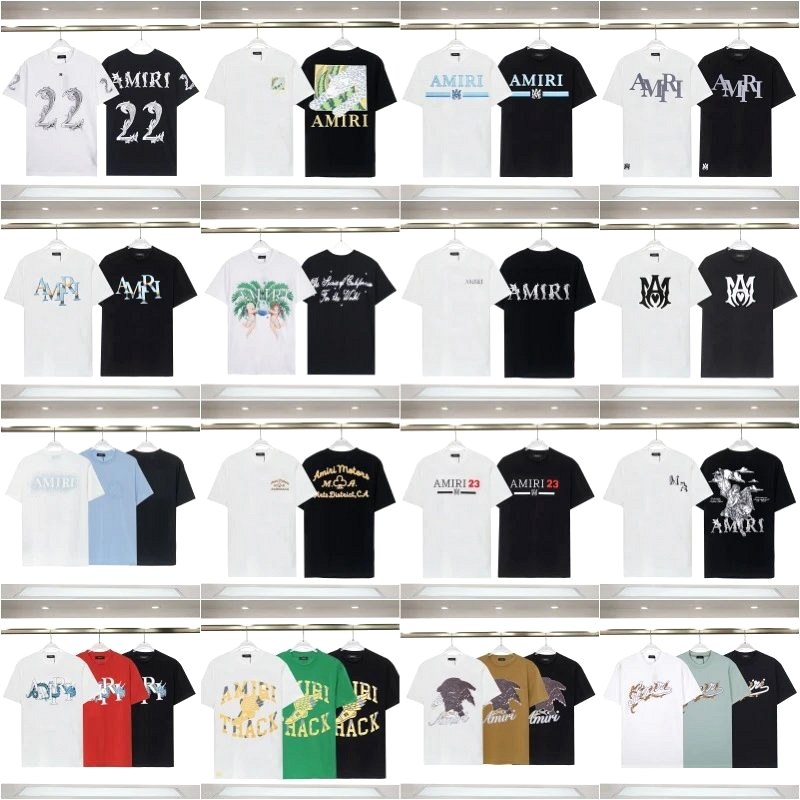
It arrived folded in a plain poly mailer — no box, no tissue, no hanger. The chest print had no scuffs, transfer marks or creasing from transit, and the neck rib sat flat rather than wavy. One thing worth flagging immediately: the listing's own pattern field says the graphic is a number print, while the product name and the photos show lettering. Our sample is lettering. If the exact graphic matters to you, treat the spec sheet as the weaker source and the photographs as the stronger one.
Measurement tolerance stated on the listing is 1–3 cm, sizes run S–XXXL, and the colour run is long — white, black, red and blue variants spread across dozens of option codes, including families like 827, 83xx and 8365.
Fabric: what the 180–250 g/m² claim looks like on a scale
The listing states 100% cotton in a plain weave, breathable, wrinkle resistant, moisture wicking, colour fast, at a "regular" thickness quoted as 180–250 g/m². We weighed our size L sample and derived an approximate grams-per-square-metre figure from its flat dimensions.
| Check | Our result, size L | Note |
|---|---|---|
| Garment weight (digital scale) | 190 g | Single sample, before washing |
| Derived fabric weight | ≈240 g/m² | Approximation; trim and neck rib add unmeasured mass |
| Stated fabric weight | 180–250 g/m² | Our estimate sits in the upper half of the band |
| Hand feel | Dense, dry, minimal slub | Heavier than a standard department-store tee |
The derived figure is arithmetic, not a lab cut test — we folded the flat chest width and body length into an area estimate and allowed for the fabric running on both faces of the shirt. Read it as consistent with the stated band rather than as proof of it. What we can say plainly is that the cotton feels more substantial than the $8.36 price suggests, matching third-party comments that Amiri tees use heavier fabric than a standard tee.
Flat measurements and what three washes did
We taped the shirt flat on the bench and repeated the same measurements after each of three cold machine washes, air-dried flat and reshaped damp, following the cold-wash instruction on the care label.
| Measurement | Before wash | After 3 washes | Change |
|---|---|---|---|
| Chest, flat | 55.0 cm | 54.5 cm | −0.9% |
| Body length, shoulder seam to hem | 71.0 cm | 70.0 cm | −1.4% |
| Shoulder width | 51.0 cm | 51.0 cm | none measured |
| Sleeve length | 21.0 cm | 20.5 cm | −2.4% |
Movement stayed inside the listing's own 1–3 cm tolerance and toward the low end of what knit cotton typically does: tight, compacted jersey often moves 1–3% over its first washes, while untreated 100% cotton can lose 3–5% in length and start noticeably shorter rather than narrower. This sample behaved like the first group. That is one shirt, washed three times — not a claim about the whole production run.
On fit, the listing describes a relaxed, loose cut, while third-party sizing guidance says Amiri tops generally run slightly small and recommends sizing up for a looser feel. The two statements pull against each other, which is why we measured rather than assumed: our size L has a genuinely relaxed chest and a hem that sits mid-fly. The safest route remains asking the seller for flat chest and length numbers in your size before checkout.
The print: abrasion, daylight and shade
The logo is a dye print, and the durability evidence around it is mixed rather than settled. One buyer at an authorized retailer reported the printed lettering cracking noticeably within roughly 18 months, despite limited wear and dry cleaning as directed. A separate buyer described a metallic smell developing after a few months and persisting after washing.
We ran a thumb-rub abrasion check — 50 firm passes over the lettering with a white cloth — and saw no measurable ink transfer or visible break in the print edges. That tells us the ink bonded on this sample out of the mailer. It does not predict two years of wear; a thumb rub cannot reproduce 18 months of abrasion, laundering and folding, so we treat print longevity as the weakest link in this purchase.
Shade is the second soft spot. In QC and legit-check threads, buyers debate whether the printed logo should read as brighter yellow, noting photos of it can look noticeably more faded. We checked our lettering in direct daylight, open shade and indoor light and found it reads duller than a bright reference, but with only one colourway in hand we cannot verify the palette across the dozens of listed options.
Choosing from a 55-code colour list
- The option list mixes print families with colour names: 827, 808, 809, 8356, 8357, 8365, 8380–8399, 8329, 8317, 8319, 8302, 8252, 8183, 8178, 8008, D211 and more, mostly paired as white and black, with red and blue on some codes.
- Two looks can share a colour name and still differ in graphic — 8365 splits into black-blue, black-red, white-red and white-blue.
- Because we could not verify every shade, choose from the product-specific photographs in the code you intend to buy, not from the colour word alone.
Care and how we would protect the print
- Wash cold and inside out, then air dry flat or hang. Heat and tumble drying are what accelerate both shrinkage and print breakdown.
- Reshape damp rather than pulling hard on a dry print, which is where lettering edges start to fracture.
- Skip dry cleaning as a print-protection strategy — it did not prevent cracking for the buyer who reported it.
Our conclusion tracks the price. The cotton, weight and washed-in silhouette are stronger than $8.36 normally buys, and the measurement behaviour was tame. The print is the part we grade with a question mark attached, because the only long-term durability report we found on this graphic is a failure at about 18 months and the logo shade cannot be confirmed from photographs. Testing notes: one size L sample, three cold washes, thumb-rub abrasion, daylight shade check, digital scale and flat measurements; no independent buyer feedback exists on this exact listing.
- How we tested
We bought size L at $8.36, weighed it on a digital scale, taped flat measurements, then cold-washed three times and re-measured. Print was checked with a 50-pass thumb rub and viewed in daylight, shade and indoor light. Single sample only.
Sources and notes
- Catalog product page
Product listing verified on 2026-10-12.
Did the tee shrink after washing?
Ours moved very little: about 1.4% shorter and 0.9% narrower in the chest after three cold washes, dried flat. That stayed inside the listing's 1–3 cm tolerance. One size L sample only, so treat it as a guide, not a guarantee.
How should I wash it to keep the print intact?
Cold water, inside out, air dry flat or hung, and reshape while damp instead of pulling a dry print. Tumble drying and heat are the main drivers of both shrinkage and print cracking. Dry cleaning did not save one buyer's lettering.
Why are there 55-plus colour codes on one listing?
The codes pair print graphics with colour names, so 8365 alone covers black-blue, black-red, white-red and white-blue. Two items sharing a colour word can still carry different graphics, so pick from photos of the exact code rather than the name.